Feature
See the shape of your library
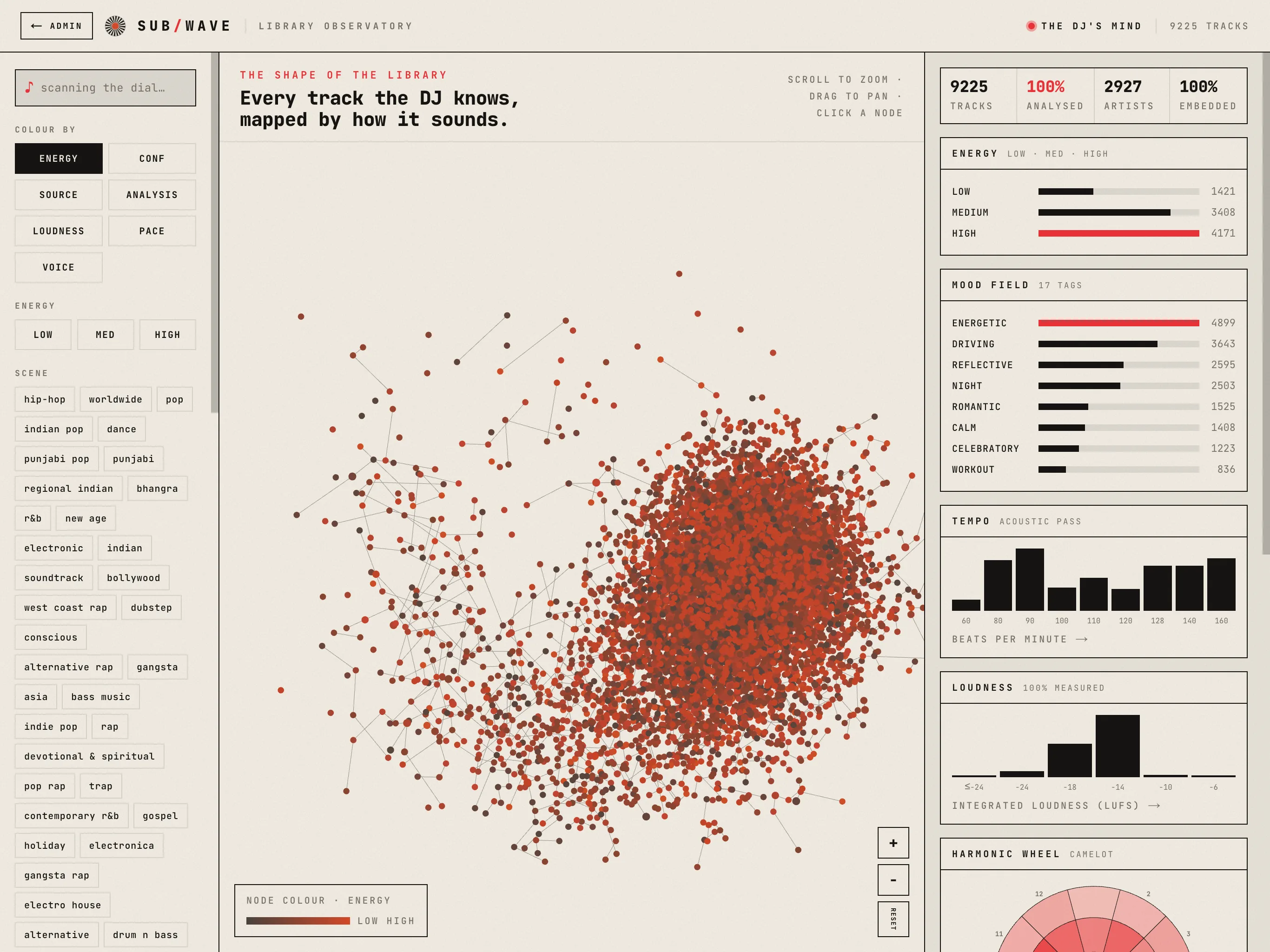
The Library Observatory is a full-screen map of every track your DJ has tagged, placed by genre and lit by energy. Click any point to read its full record.
The DJ holds a lot in its head: every track's mood, energy, tempo, key, and a pair of learned vectors. Until now you could only read that one row at a time on the Library page. The Library Observatory turns the whole thing into one picture.
What's new
It's a full-screen map of every track you've tagged. Each one is a point, sitting near others in its genre, lit on an ink-to-vermilion ramp by how energetic it is. Faint lines wire close neighbours together. Pan around, scroll to zoom.
The panels down the right keep a running count:
- Energy split and mood field
- A tempo histogram and a loudness histogram
- A Camelot key wheel
- The major/minor and vocal/instrumental balance
How to use it
Open admin and click Observatory in the nav, or go straight to:
/observatory
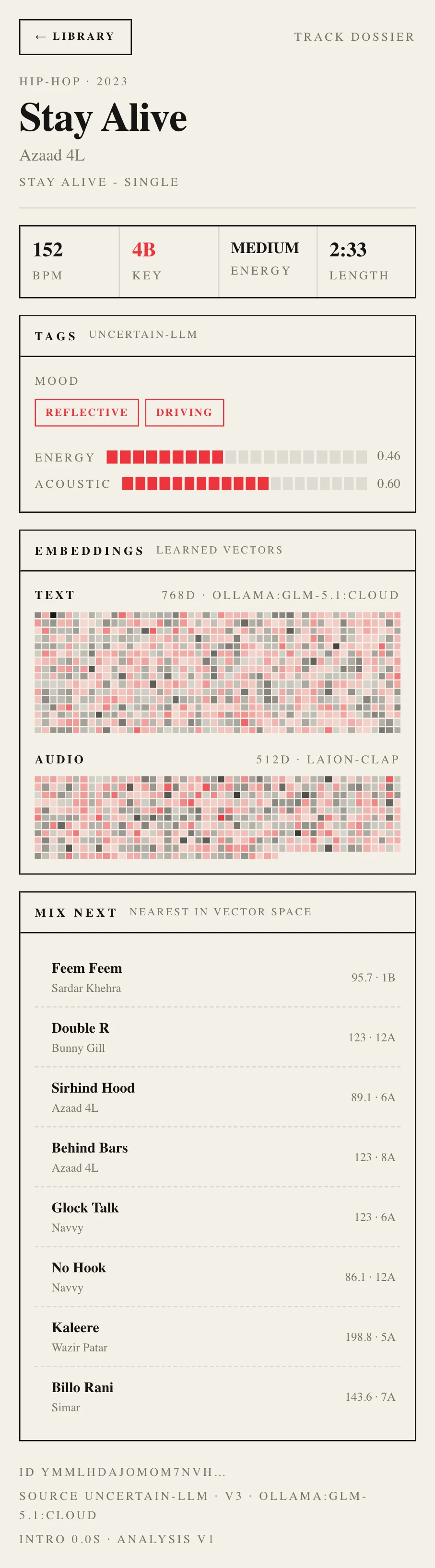
Click any point to open its dossier: BPM, key, energy, loudness, its mood and last.fm tags, and the track's text and audio fingerprints. There's a song-shape timeline too, charting the track end to end: its pace curve, where the intro ends, the sections, the vocal passages, and how the key moves over time. Under that sits Mix Next, the closest tracks in vector space, with the links drawn back onto the map. Recolour the map by energy, confidence, tag source, analysis, loudness, pace, or voice from the left rail, and filter by scene, mood, or tag source.
Big library? Use the MAP SIZE control in the rail. It draws up to 25,000 tracks by default and goes to 100,000. Past that it shows an even sample across genres, so the shape stays honest.
Why it helps
It's the DJ's mind, laid out. The dense corners of your collection are obvious, and so are the thin ones. You can see where a genre clumps together and which tracks drift off on their own. It's also just a nice way to wander your own music and turn up things you forgot you had.